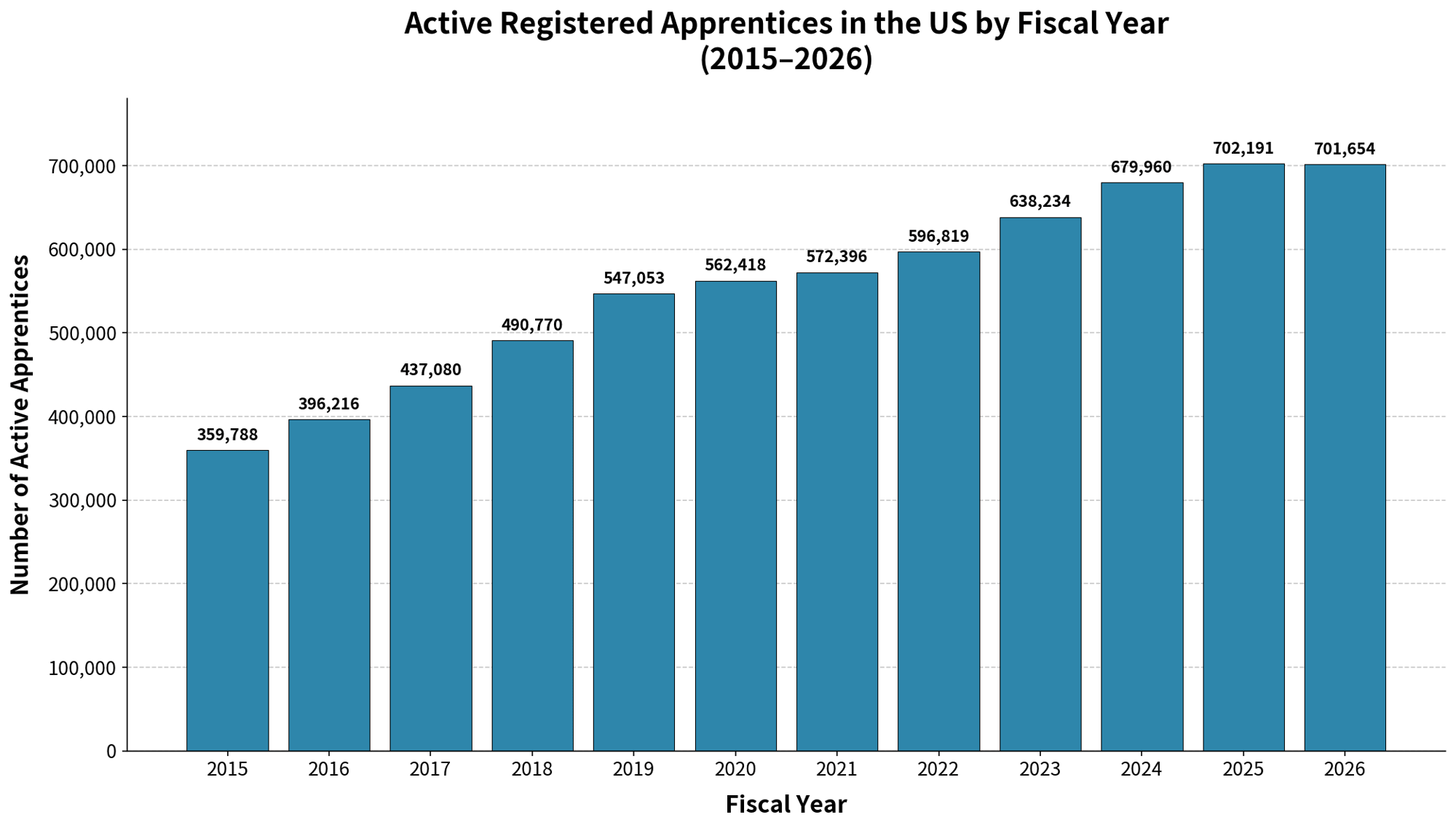
Apprenticeships are booming — there are currently 702,000 registered apprentices in the US, roughly double the level of a decade ago — and for good reason. When so many other career paths are starting to look shaky or not worth the effort, apprenticeships stand out as a rock solid way to gain high-value skills while getting paid at the same time.
Apprenticeship programs typically last one to six years, depending on the occupation, and culminate in a nationally portable credential, such as a journeyworker certificate, that signals proficiency to employers nationwide. The credential is key — this isn’t just learning on the job — it’s training, working toward a valuable certification.
Getting paid while you learn sounds great, but how exactly do you get an apprenticeship? This post explains the process in six steps.
Step 1. Choose Your Target Field

The vast majority of apprenticeships are in blue collar skills employed in the construction and manufacturing industry, but there are apprenticeships in other areas as well, such as IT and healthcare. One of the best ways to figure out which skill set or industry works best for you is to simply look through available apprenticeships. You can do that at Apprenticeship.gov, the largest site for such openings, currently with out 8,000 apprenticeships listed. For the apprenticeships you find of interest, note the typical requirements, wages, and program length.
Also, make sure you understand what an apprenticeship typically entails — how much it’s likely to pay, how long it will take, pluses and minuses, etc. You can learn more about apprenticeships here.
Step 2. Meet (And Exceed) Basic Eligibility Early

Most apprenticeships require applicants to be age 18+, and have a high school diploma/GED, valid driver’s license, and ability to do physical work. Some (especially electrical) need algebra or aptitude-test readiness. If relevant, get quick, inexpensive credentials like OSHA 10/30, First Aid/CPR, or a clean drug screen/physical — these strengthen applications and help during wait periods.
Step 3. Build Relevant Experience And Stand Out

There will be multiple applications for any available apprenticeship, so your application needs to make a strong, positive impression. The best way to do that is to engage in activities that enable you to learn relevant skills and demonstrate real interest.
Consider pre-apprenticeship programs (high conversion rates into full apprenticeships in construction and healthcare). These are generally short-term training positions that build foundational skills. You can find programs local to you by doing a web search for the term pre-apprenticeship or by searching the pre-apprenticeship links at Apprenticeship.gov
Other useful options include related entry-level related jobs, vocational classes, or even personal projects (home repairs, mechanics, coding, etc.). Anything that demonstrates interest and aptitude helps.
A more serious and committed option — which may lead to a job even without an apprenticeship — would be to earn one of the more valuable skill certifications. These generally take less than six months to complete and a modest investment in training (usually less than $5,000). A list of some of the highest-return skill certifications is here. If the certification you select is in the trades or blue collar area, consider applying for a MikeRowe blue collar scholarship to help with the cost of training.
Step 4. Search Systematically And Contact Programs Directly

Start with the official resources at Apprenticeship.gov. Use the Apprenticeship Job Finder to search open positions by location, occupation, or keywords; results often link directly to employer applications and note whether the program is registered. Make sure that any apprenticeship you apply for ends in a certification. Otherwise it’s just on-the-job training, which is nice but it’s not the same as getting a credential.
If no immediate openings appear, switch to the Partner Finder tool. There you can search by state, county, industry, or organization name to locate sponsors, including unions and training committees, then contact them about upcoming application periods.
For traditional skilled trades such as electrical, plumbing, sheet metal, or ironwork, focus on local union halls and their Joint Apprenticeship and Training Committees (JATCs). A JATC is a joint labor-management body that sets standards, runs classroom instruction, oversees on-the-job training, and ranks applicants. To find the right one, enter your trade and city into the Partner Finder, Google “[trade] JATC [your city/state],” or call the nearest union local (for example, an IBEW hall for electricians). Most JATCs open applications only during fixed windows — annually, quarterly, or for a few weeks — and place candidates on ranked lists based on aptitude-test scores, interviews, education, and related experience.
Non-union or contractor-sponsored routes often move faster. For instance, Associated Builders and Contractors (ABC) is a national trade association of merit-shop construction firms that operates hundreds of registered apprenticeship programs through its local chapters. Visit abc.org, locate your nearest chapter, and inquire about openings; many require you first to secure a job with a participating contractor before classroom training begins.
Finally, visit an American Job Center (find one at careeronestop.org). Counselors can match you with local openings, help with résumés, and connect you to funding. Because many programs fill through internal referrals, consider taking an entry-level helper or laborer role at a company already sponsoring apprenticeships — this “foot-in-the-door” experience frequently leads to formal indenture.
Step 5. Prepare Strong Applications And Apply Strategically

Tailor your resume and any cover letter — highlight relevant skills, reliability, and why this trade/employer. Apply to multiple programs, and follow up. Practice for interviews and aptitude tests (basic math is common for some trades). And when it comes to the actual interview, be sure you can answer the three questions every recruiter wants to know.
The application process takes persistence — you will need to apply to multiple apprenticeship programs until one hires you, but success rates are higher with low volume/concentrated effort applications (i.e., good preparation, direct outreach, and relevant experience) rather than mass generic applications.
Step 6. Don’t Forget Networking

Try to talk to current apprentices or journeyworkers. They may know of opportunities or have tips on how they got through the process. Use LinkedIn or local contacts for referrals.
Seek out job/career fairs, open houses, or information sessions. American Job Centers often host or know about these.
What To Expect
Waitlists are common in popular programs — use the time to strengthen your profile. Treat it as a multi-month (sometimes a year or more) process rather than a quick application, especially for competitive trades with limited intake windows or waitlists.
If you stick with it, your effort will pay off in a big way. An apprenticeship isn’t just on-the-job training. It’s about earning a certification that will make you employable at a solid wage for the rest of your life. The process of getting that certification is an investment in yourself and your future. To start on that path, scroll back up to Step 1.